

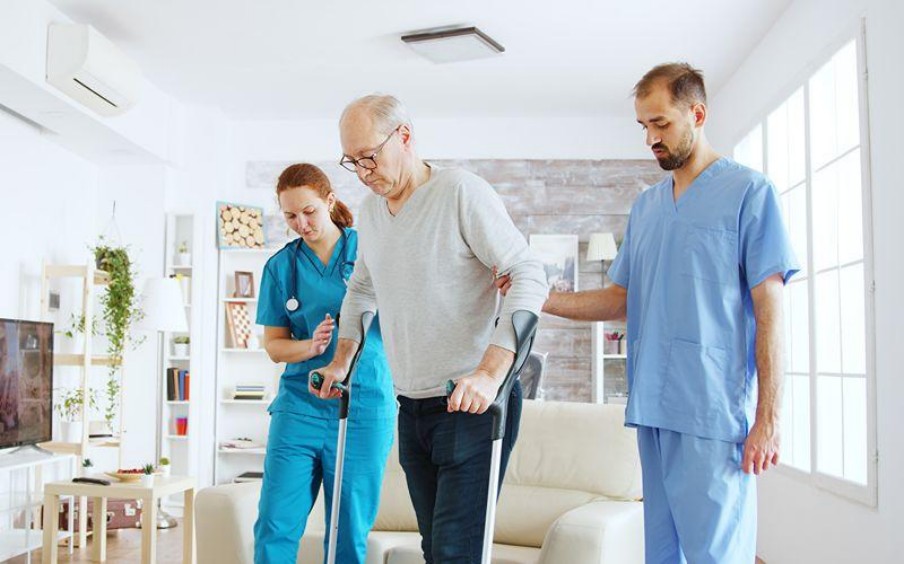
Stroke rehabilitation at home is frequently chosen because it feels continuous rather than disruptive. Hospital care ends, and home rehabilitation services begin, allowing recovery to progress without interruption. This smooth transition creates a subtle risk. Rehabilitation can slowly change purpose without anyone naming it. What starts as active neurological recovery can settle into preservation of existing function. Families remain engaged, sessions continue, and effort stays visible. Yet progress becomes harder to identify. The problem is not commitment or care quality. It is how stroke rehabilitation at home can quietly redefine recovery as maintenance rather than advancement.
1. When Early Gains Reset The Definition Of Progress
Initial improvements after stroke feel dramatic. Standing becomes possible. Transfers require less help. Walking begins with support. Once these milestones appear, they become the new baseline. Home rehabilitation services then focus on sustaining these gains rather than extending them. Exercises repeat successfully, reinforcing stability. Without deliberate recalibration, therapy protects existing ability instead of expanding it. Progress slows because the goalpost stops moving.
2. How Familiar Routines Replace Progressive Challenge
Home environments reward predictability. Furniture stays fixed. Daily paths remain unchanged. Stroke rehabilitation relies on exposing the nervous system to varied demands. At home, repetition happens within the same constraints. Patients master tasks in one context without adapting to others. Familiar routines improve confidence but reduce neurological demand. Recovery shifts toward efficiency within limits rather than adaptability beyond them.
3. When Safety Prioritisation Shrinks Recovery Scope
Fall risk after stroke remains a concern. In home settings, safety decisions dominate treatment choices. Therapists reduce the risk of an incident. Families reinforce caution during daily activities. Over time, risk avoidance narrows what rehabilitation attempts. Home rehabilitation services protect function successfully, yet recovery depth diminishes as the challenge fades. Safety remains intact while progression stalls.
4. How Caregiver Assistance Becomes Automatic Support
Caregivers naturally step in when movement looks difficult. Assistance becomes habitual rather than situational. Stroke recovery requires controlled effort and occasional struggle. Automatic support removes the need to problem-solve physically. Patients complete tasks with help instead of developing independence strategies. Stroke rehabilitation at home becomes a collaborative movement rather than a relearning movement, subtly altering recovery direction.
5. When Session Consistency Masks Reduced Intensity
Regular sessions create reassurance. Therapy appears ongoing and structured. Intensity, however, matters more than frequency. As patients stabilise, exercises remain familiar and achievable. Without escalation, sessions maintain ability rather than challenge capacity. Home rehabilitation services continue reliably, yet neurological demand declines. Maintenance feels productive because activity continues, even as recovery plateaus.
6. How Subjective Progress Replaces Measured Change
In home settings, progress is often judged by comfort, confidence, or reduced frustration. These markers matter, but they do not capture coordination quality, endurance, or movement efficiency. Without shared metrics, subtle decline or stagnation passes unnoticed. Stroke rehabilitation at home can feel successful while functional capacity remains unchanged. Measurement gives way to perception.
7. When Stability Signals Completion Instead Of Transition
Reaching a stable routine feels like success. Families interpret consistency as readiness to maintain. Rehabilitation shifts into preservation mode without deliberate decision. Stroke recovery, however, continues to respond to challenges long after stability appears. Home rehabilitation services risk ending prematurely when stability becomes the endpoint rather than a phase.
Conclusion
Stroke rehabilitation at home does not abruptly fail. It gradually changes purpose. What begins as recovery can become protection of existing ability through routine, caution, and familiarity. This shift explains why effort remains high while progress slows. Recognising maintenance as a distinct phase rather than an invisible default allows recovery decisions to regain direction. Without naming this transition, rehabilitation continues without advancing, and time becomes the quiet cost.
If stroke rehabilitation at home has settled into routine without further change, contact The Home Physio to evaluate whether the current home rehabilitation services still challenge neurological recovery effectively.